
As You Go Through Life

In conversation with the poems

Poems by others, read closely and answered in reflection.

Ella Wheeler Wilcox’s poem “As You Go Through Life” is a gentle reminder and an invitation to reflect on how we respond to life’s inadequacies, challenges, and purpose. Reading it today, I was struck by how relevant its message is in a world that often encourages complaint rather than compassion.
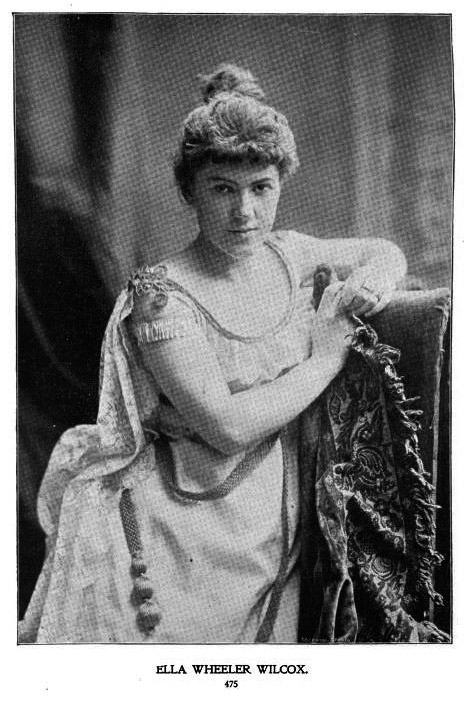
Picture by: https://commons.wikimedia.org/wiki/File:Ella_Wheeler_Wilcox,_1896.jpg

Ella Wheeler Wilcox

“A Life Shaped by Hard-won Wisdom”

            Isabella Wheeler, also known as Ella Wheeler, was born in Johnstown, Wisconsin, USA, on November 5, 1850. She was an American poet, journalist, and novelist whose work in the 19th and 20th centuries provided insightful reflections on life, love, and perseverance. Her style and themes often relate to and carefully blend her personal experiences with ideas of change, suffering, sentiments, and human emotions.

            Wilcox’s personal experiences shaped her writing, including financial struggles, a near-fatal bout with typhoid fever, and the intricacies of her 1884 marriage to Robert Wilcox.

            She died in 1919, leaving behind a body of memorable work that established her as a captivating figure in American literature.

As You Go Through Life
By
Ella Wheeler Wilcox


Don't look for the flaws as you go through life;
And even when you find them,
It is wise and kind to be somewhat blind
And look for the virtue behind them.
For the cloudiest night has a hint of light
Somewhere in its shadows hiding;
It is better by far to hunt for a star,
Than the spots on the sun abiding.

The current of life runs ever away
To the bosom of God's great ocean.
Don't set your force 'gainst the river's course
And think to alter its motion.
Don't waste a curse on the universe—
Remember it lived before you.
Don't butt at the storm with your puny form,
But bend and let it go o'er you.

The world will never adjust itself
To suit your whims to the letter.
Some things must go wrong your whole life long,
And the sooner you know it the better.
It is folly to fight with the Infinite,
And go under at last in the wrestle;
The wiser man shapes into God's plan
As water shapes into a vessel.

Poem Interpretation

“As You Go Through Life” by Ella Wheeler Wilcox is composed of three stanzas of eight lines each, employing simple, direct language to convey timeless moral and spiritual truths.

In the first stanza, Wilcox acknowledges human faults and imperfections. Rather than encouraging judgment, she gently reminds us to look beyond shortcomings and recognise the goodness within people. This perspective calls for compassion—an attitude that reflects both emotional maturity and spiritual grace.

The second stanza highlights our tendency to complain when life gets tough. The line “Don’t waste a curse on the universe” acts as a reminder that resentment and blame hardly change our situation. Instead, challenges become opportunities—times that can build character, increase understanding, and teach patience if we let them.

In the final stanza, the poem offers a humbling realisation: the world does not exist to conform to our wishes. We are, instead, shaped by life’s experiences to fulfil a greater purpose. There is comfort in this idea—that even hardship may serve a sovereign design leading us towards meaning and growth.

Overall, Wilcox encourages readers to face life with humility and faith, trusting that what they encounter is not a coincidence. When seen this way, life’s trials become less heavy and more like blessings—quietly guiding us toward a greater sense of purpose aligned with God’s plan.

Till next time,

Cheers
References:

As you go through life by Ella Wheeler Wilcox. (n.d.). All Poetry – The world’s largest poetry site : All Poetry. https://allpoetry.com/As-You-Go-Through-Life

Ella Wheeler Wilcox. (1999, July 2). Encyclopedia Britannica. https://www.britannica.com/biography/Ella-Wheeler-Wilcox

Ella Wheeler Wilcox [Photographic Portrait]. (2016, January 15). commons.wikimedia.org. https://commons.wikimedia.org/wiki/File:Ella_Wheeler_Wilcox,_1896.jpg

Ella Wheeler Wilcox. (2025, November 18). Literary Devices. https://literarydevices.net/ella-wheeler-wilcox/#google_vignette

Ellan Wheeler Wilcox. (n.d.). Poetry Foundation. https://www.poetryfoundation.org/poets/ella-wheeler-wilcox

Phenomenal Woman

Every year, International Women’s Day (IWD) is celebrated in many countries worldwide on March 8 to honour all women and celebrate women’s social, economic, cultural, and political achievements.  

Today, I would like to share a beautiful poem by Maya Angelou. “Phenomenal Woman” is one of Angelou’s most famous poems, and it celebrates the most remarkable beauty and female strength, freshness, and vigour. The poem addresses the traditional expectation that the ideal feminine beauty was fashion models. But first, here’s a little bit about Maya Angelou.

Maya Angelou, born Marguerite Ann Johnson in St. Louis, Missouri, was born on April 4, 1928. Her nickname “Maya” was given to her by her older brother, Bailey. Angelou was an American poet, memoirist, writer, actor, director, and producer. She published several autobiographies, books of essays, and several books of poetries. Angelou had a distinguished career as a singer and dancer and performed professionally in the US, Europe, and northern Africa. She was a civil rights activist working with Dr Martin Luther King Jr. and Malcolm X (Poetry Foundation, n.d.).

Angelou lived with her paternal grandmother when she was young after her parents divorced. Four years later, Angelou returned to her mother briefly but was raped by her mother’s boyfriend when she was seven. He went to jail and got killed after being released from prison. She believed her confession led to the man’s death because she said his name. Angelou refrained from speaking and became temporarily speechless for six years. During this period of silence, Angelou developed her love for books and literature. She returned to her grandmother’s care in Arkansas.

Before the start of World War II, Angelou moved back in with her mother in California and went to George Washington High School, and attended dance and drama courses at California Labor School. When the war broke out, Angelou worked as a streetcar conductor. She worked for a while but decided to return to school, graduated from Mission High School in 1944 and gave birth to her only child, Clyde Bailey Johnson. In 1949, Angelou married Tosh Angelos, an electrician in the US Navy. They divorced in 1952, and she kept his surname throughout her life.

In 1981, she became a professor of American Studies at Wake Forest University, Winston-Salem, North Carolina, despite her lack of a college education. The Wake Forest University Writers Hall of Fame inducted Angelou in 2012. She composed and delivered a poem, “On the Pulse of Morning”, for the inauguration of US President Bill Clinton in 1993. In 2000, President Bill Clinton awarded her the National Medal of Arts. In 2011, President Obama awarded her the Presidential Medal of Freedom, the highest civilian honour (Spring, 2017), for her outstanding and inspiring career in the arts. She was awarded 50 honorary degrees in her lifetime. Maya Angelou died on May 28, 2014.


Phenomenal Woman

By Maya Angelou

Pretty women wonder where my secret lies.

I’m not cute or built to suit a fashion model’s size

But when I start to tell them,

They think I’m telling lies.

I say,

It’s in the reach of my arms,

The span of my hips,

The stride of my step,

The curl of my lips.

I’m a woman

Phenomenally.

Phenomenal woman,

That’s me.

I walk into a room

Just as cool as you please,

And to a man,

The fellows stand or

Fall down on their knees.

Then they swarm around me,

A hive of honey bees.

I say,

It’s the fire in my eyes,

And the flash of my teeth,

The swing in my waist,

And the joy in my feet.

I’m a woman

Phenomenally.

Phenomenal woman,

That’s me.

Men themselves have wondered

What they see in me.

They try so much

But they can’t touch

My inner mystery.

When I try to show them,

They say they still can’t see.

I say,

It’s in the arch of my back,

The sun of my smile,

The ride of my breasts,

The grace of my style.

I’m a woman

Phenomenally.

Phenomenal woman,

That’s me.

Now you understand

Just why my head’s not bowed.

I don’t shout or jump about

Or have to talk real loud.

When you see me passing,

It ought to make you proud.

I say,

It’s in the click of my heels,

The bend of my hair,

the palm of my hand,

The need for my care.

’Cause I’m a woman

Phenomenally.

Phenomenal woman,

That’s me.

Till next time, enjoy the pleasures of life.


Ninagracia
__________

References

Angelou, M. (n.d.). Phenomenal Woman. Poetry Foundation. https://www.poetryfoundation.org/poems/48985/phenomenal-woman

Britannica, The Editors of Encyclopaedia. (2023, January 5). Maya Angelou. Britannica. https://www.britannica.com/biography/Maya-Angelou

Poetry Foundation. (n.d.). Maya Angelou. https://www.poetryfoundation.org/poets/maya-angelou

Spring, K. A. (2017). Maya Angelou. National Women’s History Museum. https://www.womenshistory.org/education-resources/biographies/maya-angelou

On Mother’s Day By: Bruce Lansky

This year, we are celebrating the 107th year of Mother’s Day to honour all mothers and motherhood worldwide. At the initiative and tireless devotion of Anna Jarvis, the modern Mother’s Day began in the United States. US President Woodrow Wilson officially proclaimed in 1914 the second Sunday in May as the day of celebration to honour the memories and the sacrifices of mothers made for their children.

Today, I would like to share with everyone a beautiful poem by Bruce Lansky for this occasion. Bruce Lansky is from Minnesota and America’s bestselling author of children’s poetry books. His poems are funny, hilarious, and something that will make you smile.

So, here it is…

On Mother's Day
By Bruce Lansky

On Mother's Day it isn't smart
To give your mom a broken heart.

So here are things you shouldn't say
To dear old mom on Mother's Day:

Don't tell her that you'll never eat
A carrot, celery, bean, or beet.

Don't tell her you think smoking's cool.
Don't tell her you've dropped out of school.

Don't tell her that you've drowned the cat.
Don't tell her that she looks too fat.

Don’t tell her when you're grown you'll be
A starving poet—just like me.

Happy Mother’s Day to all.

Ninagracia


References:

HANDWERK, B. (2014, May 10). Mother’s Day Turns 100: Its Surprisingly Dark History. National Geographichttps://www.nationalgeographic.com/culture/article/140508-mothers-day-nation-gifts-facts-culture-mom

History.com Editors. (2011, April 29). Mother’s Day 2021. HISTORY. https://www.history.com/topics/holidays/mothers-day

Lansky, B. (n.d.). On mother’s day by Bruce Lansky. Poetry Foundation. https://www.poetryfoundation.org/poems/58518/on-mothers-day-56d23cf7ac33d

Mother’s Day. (n.d.). NicePNG. Retrieved May 8, 2021, from https://www.nicepng.com/ourpic/u2w7i1q8w7y3q8r5_mothers-day-is-more-than-the-day-we/

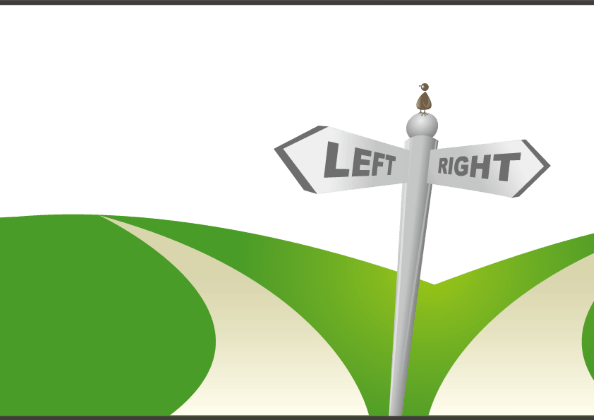
Rhythm and Rhymes: The Road Not Taken (By: Robert Frost)

The Road Not Taken

By

Robert Frost
(1874-1963)

“The Road Not Taken”  is a narrative poem published in 1916. It is one of the most famous poems that captured the fascination of so many people and often misunderstood or misinterpreted.

Some people would say that there is no single meaning or interpretation of a poem and its significance lie in the mind of the writer at the time he wrote the poem.


The Road Not Taken

Two roads diverged in a yellow wood,
And sorry I could not travel both
And be one traveller, long I stood
And looked down one as far as I could
To where it bent in the undergrowth;

Then took the other, as just as fair,
And having perhaps the better claim,
Because it was grassy and wanted wear;
Though as for that the passing there
Had worn them really about the same,

And both that morning equally lay
In leaves no step had trodden black.
Oh, I kept the first for another day!
Yet knowing how way leads on to way,
I doubted if I should ever come back.

I shall be telling this with a sigh
Somewhere ages and ages hence:
Two roads diverged in a wood, and I—
I took the one less travelled by,
And that has made all the difference. (Source)

Here’s a short recap of the poem:

The narrator in the poem encountered a problem when the road he was travelling became two separate paths. As a solo traveller, he could not take both routes. He stood for long to see where each road would lead him. Since he cannot travel on both paths, he was considering the best possible option before deciding which direction to take. However, he could not see the road very well because the forest was dense with leaves and vines.

He figured out that taking the other path was a better option because it was grassy. It looked like no one had walked there. Upon walking on that road, he realised that the grass had worn away the same as the other road because they both been travelled equally. In other words, the same number of people must have walked on that road.

Both roads have a similar condition of wear. Without uncertainty, he decided that over time he would take the other road even though he had doubts if he would ever come back there again.

At some point in the future, he would tell that he was confronted with a problem when two roads diverged in some wood. He had to make a hard choice about which route to take. His decision to take the road that was less travelled by made all the difference in his life.

**********

The Road Not Taken is the most well-known poem of our time. After reading it through, I was deeply immersed in thoughts for its complexities and sophistication.

Poems are presented to us to be enjoyed and interpreted. It is not something that we can argue or prove, instead, it is for us to understand the significance of every single word the writer was trying to express.

The message in this poem is about making a choice. Every day in our lives we make simple choices– what food to eat, what clothes to wear, what shows to watch on the television, or where to go for our next holiday. We make hard choices too where our lives, our friends and families, our total well-being, our future and career entirely depend on that choice.

Making a choice is more difficult if what we are hoping to achieve is not visible on the other side of the road. Making a wise decision and picking the right path is the choice that we all have to take.

If our actions resulted in the improvement of our lives, then that decision to take that path had a positive outcome.

No matter which road we take, it is a considerable risk, and all we can do is hope for the best. Our choices will always make a big difference in our lives.

This is my personal view of this poem. If you have your own, I’ll be glad to hear it from you.

Till next time, enjoy the pleasures of life.


Ninagracia

____________________

References:

https://www.sparknotes.com/poetry/frost/section7/page/2/
https://susanbaroncini-moe.com/please-stop-misinterpreting-the-road-not-taken/
https://en.wikipedia.org/wiki/The_Road_Not_Taken


In Conversation with the Poem: Giving

When we hear the word “giving”, the first thing we think about is a GIFT.

We give gifts to establish or strengthen our relationships with our friends and family.

“Giving” means different thing to some people. It is an emotion we feel towards other people or even to our self.

Poetry is a gift that a writer can give to their readers to help them understand themselves and even make them think.

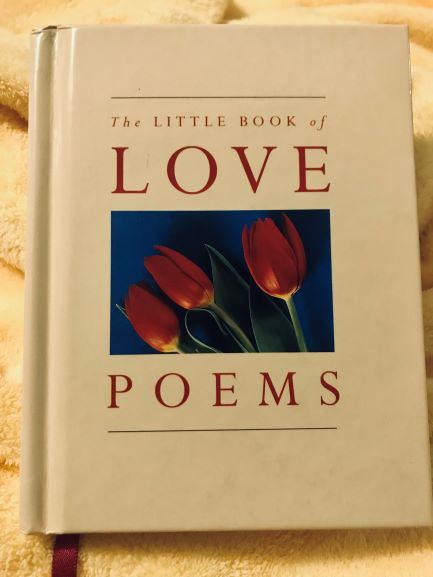
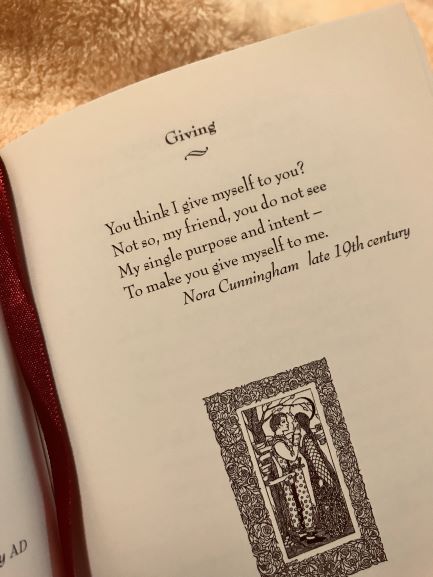
Here is a poem from The Little Book of Love Poems.

“GIVING” is written by Nora B. Cunningham. It is concise but direct, and it makes you think.

Take special note on the last line.

First, here is a snapshot of Nora B. Cunningham. From the information I gathered, here’s a little bit of who she was.

Nora Belle Cunningham was an American poet. She was born in Kansas on July 23, 1887.

Her first poem was published in “Youth’s Companion” in 1920, and her career continued for the next 55 years.

Her poems were published in magazines such as “Commonweal”, “Lyric”, “The Harp”, “Poetry”, and in newspapers such as “New York Times”, and “Kansas City Star”.

She never married and devoted her life caring for her invalid mother and a sister who became disabled by arthritis.

She died on September 28, 1975. Her papers and correspondence are archived in the collection at Wichita State University.

Meaning of the poem:

Giving is a short poem that conveys a powerful message that the author wanted to get across to her readers.

Her words were sharp and clear, that made it easy for her to connect to her readers.

The author spoke about self-love.

What she was saying was that giving was not all about love, care, and help, but it is also about helping the person you care the most to appreciate herself and her worth.

It is about liberating and giving herself a daily priority and a stamp of approval to become the person she wanted to be.

In this poem, I could only visualise what was going on the author’s mind. It made me connect with her like her desire to be a strong and independent person.

So, there you go. Feel free to send in your comment and views on this poem. I love to hear your opinion on this one.

Till next time, cheers!

Ninagracia

Sources:
https://allpoetry.com/Nora-B-Cunningham
http://specialcollections.wichita.edu/Collections/ms/79-03/79-3-A.HTML
The Little Book of Love Poems. (2002 ed.) Giving: Nora B Cunningham (late 19th  Century)

In Conversation with the Poems: The Look

I dare you, try saying this word – sphenopalatine ganglioneuralgia.

I know, I know! It’s a mouthful, isn’t it? It is already hurting my brains.

But anyway, that word, (I dare not say) is the scientific name for Brain Freeze.

We get this from eating or drinking something very, very cold.

I don’t want to go very scientific with this one, but personally, I associate brain freeze when my brain is telling me to stop, take a break or take it easy.

Writing can sometimes take away our energy. We hit a roadblock. We stop thinking, and we get distracted very easily.

We feel tired, very sleepy, and unproductive.

It is okay to rest and re-invigorate our body because our imaginations are dried up. No matter what we do, nothing comes out of our head.

So, have you tried poetry yet?

Poetry is another form of literature that we use to express our imagination.

Some people find poetry boring.

But here’s a thing: It doesn’t take long to read a poem.

Reading short passages of poetry is relaxing. It teaches us to be imaginative, most especially when interpreting the significance of every word the author was trying to convey to his readers.

When the writing becomes tight and the days seems too long, I have with me my constant companion to help me relax and help me think of new ideas for my writing.

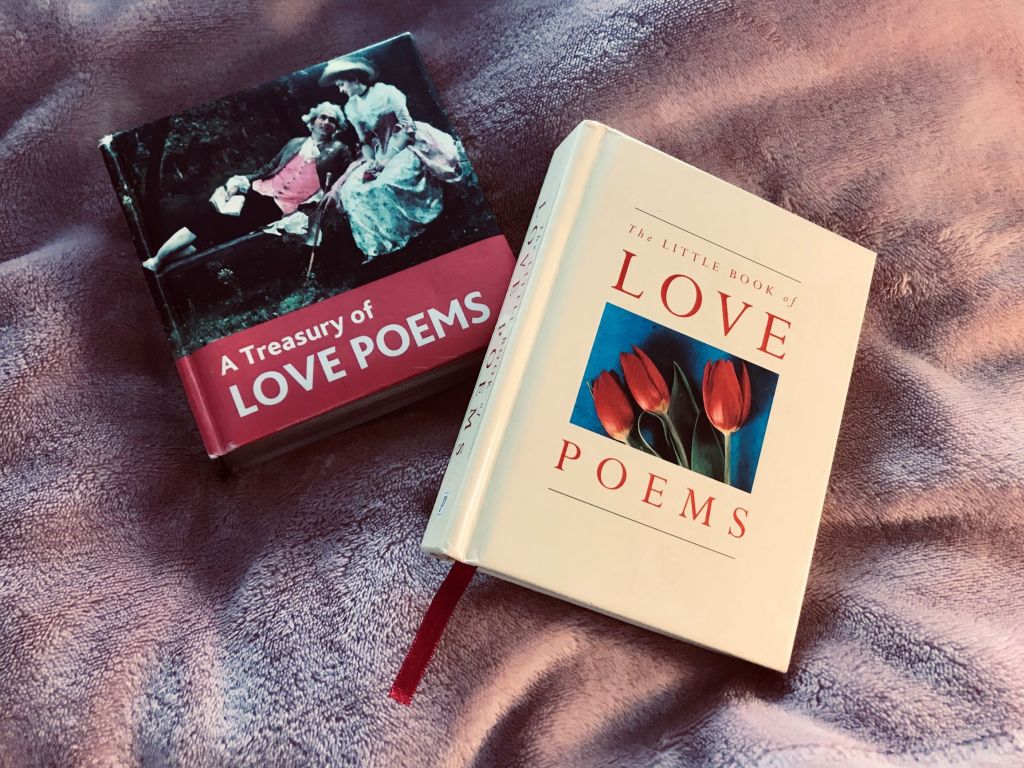
Here are my two favourite little books of poetry.

I have these books for so many years and never parted with them. They are both versatile books and easy to read. A perfect companion when you want to relax.

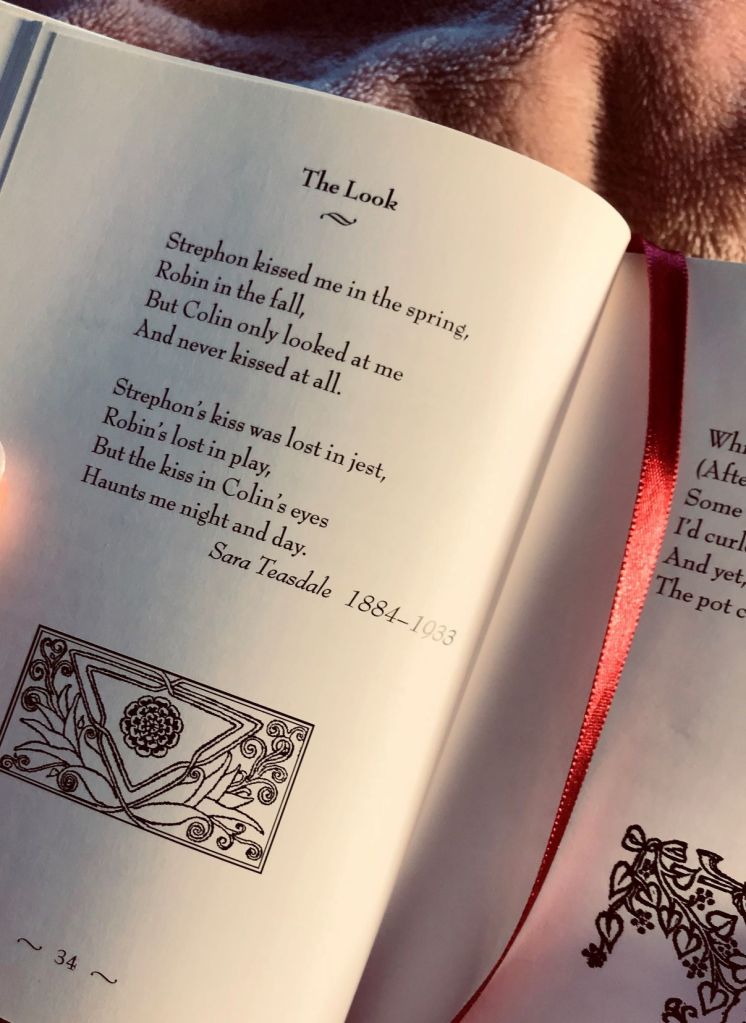
Let me show you one of my favourite poems from the Little Book of Love Poems.

The Look was written by Sara Teasdale. From the information I gathered, here’s a bit of who she was:

Sara Trevor Teasdale was born on August 8, 1884, to a wealthy family at St Louis, Missouri, U.S.A.

She was an American poet. Her work was characterised for its simplicity and clarity. Her poems are classical in style, passionate and romantic.

At a young age, she grew acquainted with Harriet Monroe and became part of Harriet Monroe’s literary circle Poetry.

In 1918, she won the first Columbia Poetry Prize, which is now known as the Pulitzer Prize for Poetry.

Her marriage to Ernst Filsinger in 1914 ended in divorce in 1929, and after that, she lived a life of a semi-invalid. After a painful bout of pneumonia, she took her own life with an overdose of barbiturates in 1933.

Sara Teasdale wrote seven books in her lifetime. Her collections of poetry include:

  • Her first volume published in 1907: Sonnets to Duse, and Other Poems
  • Her second collection published in 1911: Helen of Troy, and Other Poems
  • Her third collection published in 1915: Rivers to the Sea

Her last collection of poems in Strange Victory was later published after her death in 1933.

The Look is a very short poem, easy to read and full of passion from the author’s perspective.

In here, I can only visualise the author’s emotion, passion, and her strong desire and longing for that kiss.  Also, this poem could trigger some old feelings and sentiments to the readers that somebody has felt the same way before.

So, come on. Try reading one or two short poems every now and then. It will jazz up your mood, helps you think, and improve your creative expression.

Just remember rhythm and rhymes, and rhythm and beats. If you can easily get lost in music and songs, poetry will immerse you deep into the meaning of each word, because poetry is intoxicating, delirious, and captivating.

It is just simply lovely.

Till next time, feel free to share your favourite poem.

Cheers!

Ninagracia

Sources:

https://poets.org/poet/sara-teasdale
https://www.britannica.com/biography/Sara-Teasdale
https://www.poetryfoundation.org/poets/sara-teasdale
The Little Book of Love Poems. (2002 ed.) The Look: Sara Teasdale (1884-1933